
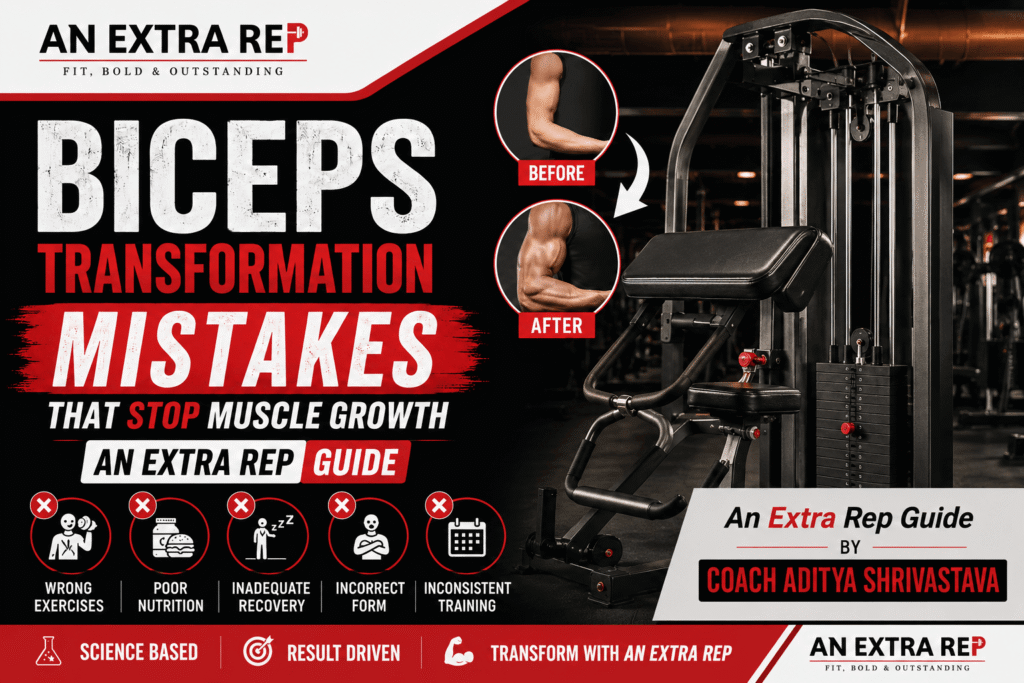
You have been curling for months. Maybe years. Yet the mirror tells the same story every single morning flat, unimpressive biceps that refuse to budge.
You are not lazy. You are not genetically cursed. You are making mistakes that most gym-goers never even know exist.
The truth is, real biceps transformation growth does not happen just by lifting heavier weights or spending endless hours in the gym. It comes from understanding what actually drives muscle growth and ruthlessly fixing what is holding you back.
Mistake #1: Chasing Weight Instead of Tension
Walk into any commercial gym on a Monday and you will see guys loading up a barbell far beyond their control, swinging their hips like they are trying to launch a rocket. That is ego lifting. And it is the number one killer of biceps transformation.
The science behind muscle growth is rooted in mechanical tension, the sustained force placed on muscle fibres through a controlled range of motion. When you jerk the weight using momentum, you transfer that tension away from the biceps and onto your lower back, shoulders, and connective tissue. The muscle that is supposed to grow simply does not receive the stimulus it needs.
Lower the weight by 20% – 30% to improve control and form. Slow the eccentric lowering phase to a full three seconds. Feel the muscle stretch under load. That stretch at the bottom of a curl is where motor unit recruitment peaks, and it is where most people rush through without thinking twice.
Mistake #2: Ignoring the Lengthened Position
According to recent sports science research, the approach to arm training has completely changed. Studies on muscle hypertrophy now confirm that loading the muscle in its stretched position not the contracted peak generates the greatest growth stimulus.
Think about a standard preacher curl versus an incline dumbbell curl. The bicep is already shortened on the preacher curl before you even start. On the incline curl with your arm draped behind your torso, the long head of the bicep is placed under a deep stretch from the very first inch of movement. That is not a minor difference, it is fundamental to produce the peaked, full look that most people spend years chasing.
Include at least one exercise per session that loads the bicep in a lengthened position. Incline dumbbell curls, cable curls performed with the cable set high behind you, and spider curls on a low incline bench all qualify. This small adjustment alone has produced visible changes in arm shape within 4-6 weeks for many athletes.
Mistake #3: Random Or Low Training Volume
Here is a question worth sitting with: do you actually know how many working sets per week your biceps receive? Not a rough estimate of the exact number?
Most trainees simply follow their program for the day, add a few curls at the end when they have time, and repeat with no consistent structure. Volume training without tracking is one of the most common reasons people plateau despite consistent gym attendance.
For meaningful biceps transformation, current evidence in fitness coaching suggests a weekly volume of 12 to 20 direct sets distributed across two to three sessions. Below that threshold, the growth signal is insufficient. Above it without adequate recovery you begin to accumulate junk volume that fatigues the elbow tendons without producing meaningful hypertrophy.
Progressive overload means gradually increasing your training challenge over time through more weight, extra reps, or additional sets. If your muscles keep doing the same work every week, growth eventually slows down. Track your workouts. Improve them regularly, and give your body a reason to adapt and grow.
Mistake #4: Treating Both Bicep Heads the Same
Your bicep is not just one muscle. It has a long head and a short head. Every curl variation has a different impact. Yet the majority of gym-goers rotate through the same three exercises indefinitely, leaving entire regions of the arm underdeveloped.
The long head is located along the outer part of the bicep and helps create the arm’s peak appearance. To target it, use narrow grip curls, hammer curls, and incline curls where the arm travels behind the body.
The short head contributes to width and fullness when the arm is viewed from the front. Wide grip barbell curls, concentration curls, and cable curls with the elbow positioned forward all shift emphasis toward this inner portion.
A well-structured bodybuilding coaching program will cycle both heads intentionally. Not randomly selecting exercises, but choosing them based on what each movement biomechanically emphasises and what the athlete needs most based on their current arm development.
Mistake #5: Underestimating Nutrition and Recovery
Here is where the conversation shifts from training to the full picture because you can execute every rep with perfect technique, follow ideal volume protocols, and still see no meaningful muscle growth if your nutrition and sleep are falling short.
Muscle protein synthesis, the cellular process that actually builds new muscle tissue requires adequate dietary protein. The current consensus in sports nutrition points to 1.6 to 2.2 grams of protein per kilogram of bodyweight daily for individuals pursuing hypertrophy. Below that range, the body simply does not have the raw material to construct new muscle regardless of how hard you train.
Sleep is not a recovery tool, it is where muscle growth actually occurs. Growth hormone secretion peaks during deep sleep phases. Cortisol, the stress hormone linked to muscle breakdown, is better regulated when you get proper quality sleep. Seven to nine hours is not a suggestion for serious athletes. It is a training variable.
Mistake #6: No Mind-Muscle Connection
This one sounds like gym folklore until you look at the research. Multiple studies have confirmed that deliberately focusing your attention on the muscle being worked rather than just moving the weight from point A to point B measurably increases bicep activation during curling exercises.
The mind-muscle connection is not mysticism. It is neuromuscular recruitment. When you internally cue yourself to squeeze and contract the bicep throughout the movement, you activate a greater percentage of the available muscle fibres. That means more tension, more damage, more repair and ultimately more growth.
A practical way to build this: perform one warm-up set of cable curls at very light weight. Do not think about the weight. Think exclusively about the muscle. Feel it lengthen on the way down. Feel it contract on the way up. Carry that awareness into your working sets. Over time, this becomes second nature and it changes the quality of every set you perform.
Ready to Fix These Mistakes for Good?
Reading about these mistakes is step one. Fixing them under the guidance of someone who has spent years studying both the science behind muscle growth and the practical realities of coaching real athletes is where real transformation begins.
If your arms have been stuck and you are tired of training hard without results, reach out directly. Whether you are looking for structured fitness coaching, a complete bodybuilding coaching program, or simply a scientifically sound training plan built around your schedule and body, drop a message, book a consultation, or follow for weekly training content that goes far beyond the generic advice flooding your feed. Your biceps transformation is waiting on the other side of the right adjustments.
Biceps transformation is not a mystery, it is a system. A system that works when every variable is dialled in correctly. To summarise what this guide has covered:
• Control the weight – tension on the muscle drives growth, not the load you move.
• Load the lengthened position stretched fibres under load produce the strongest hypertrophy signal.
• Track and progress your volume 12 to 20 weekly sets, systematically increased over time.
• Target both heads deliberately: long head for peak, short head for width.
• Prioritise protein and sleep training without recovery is just damage without repair.
• Build the mind-muscle connection. The quality of contraction matters as much as the quantity of sets.
These are not tips, they are the building blocks of an AnExtraRep program that works. As Fitness Coach Aditya Shrivastava explains, real biceps transformation comes from consistency, smart training, proper recovery, and the patience to trust the process. Stay committed, and the arms you have been working toward will follow.